
Some decisions
don't come with an A or a B.
Not every situation is multiple choice. At open decision points, you write your own answer, spoken or typed, and the training compares it to the one from the expert who built the scenario.
When the multiple choice goes away, your head works harder.
You can't recognise the right answer from a list, you have to produce it yourself. That pressure is exactly the point. It's the closest thing to the real operation you can train at a desk.
On the real call, dispatch asks where you are and you answer in your own words. A patient tells you something you didn't expect, and your next question depends on what you just heard. No list covers that. Open response trains exactly this: the decision you build yourself, under pressure, out loud.
You reach the buried person after 12 minutes. Probing shows around 80 cm depth. How do you dig?
- A Dig straight down from above
- B Approach from the side as a team
- C Re-probe with the transceiver first
not an option here!
This is where AI earns its place.
In most e-learning, AI means auto-generated filler no one needed. Open response uses it for one thing, and it does that one thing well: it reads what your team actually says, in their own words, spoken or typed, and holds it against the model answers your own experts wrote. Every learner. Every time. The instant they answer.
That used to be impossible at scale. A human expert can't sit next to 200 people and grade every open answer the moment it's given. Now the standard your expert set runs for everyone, continuously. The expert stays the authority. The AI is the engine that makes their judgment available to everyone, on every run.
This runs on the same format schneeWISE uses in live avalanche training, with decisions graded against answers certified mountain guides defined.
A stranger is standing in front of you.
No multiple choice. You type, or you speak. What the person says next depends on what you asked. So does your next step.
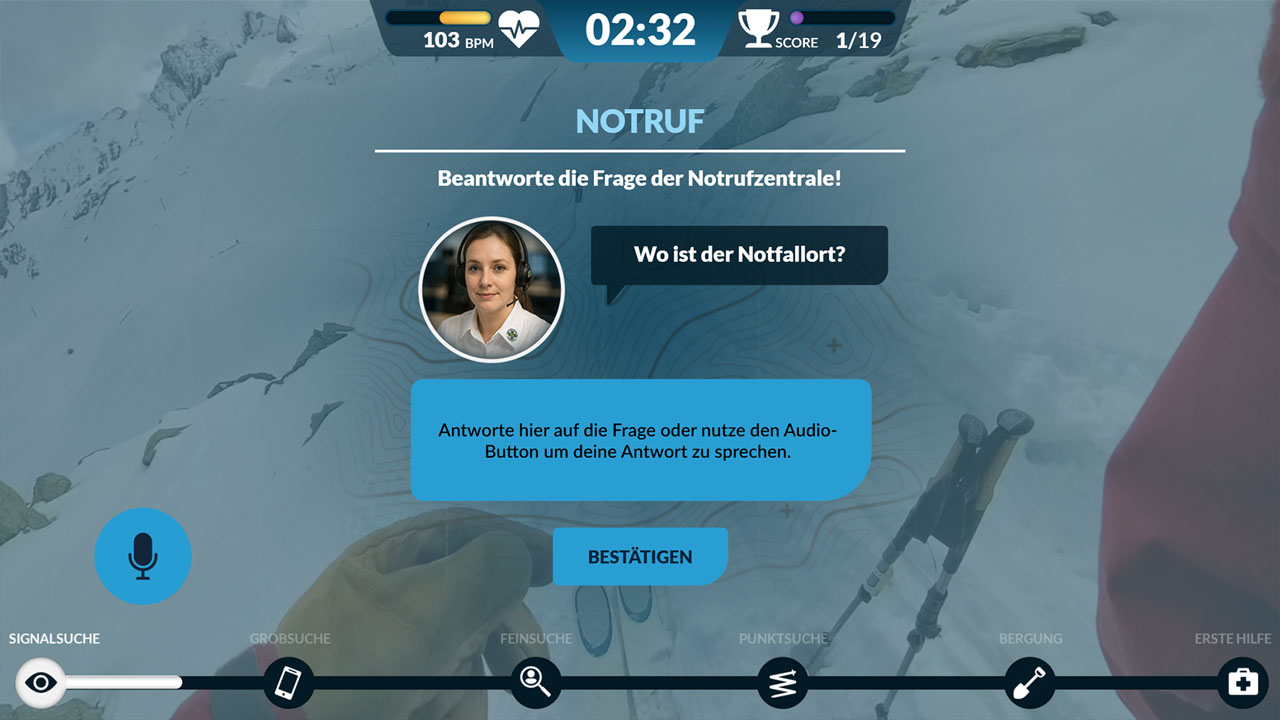
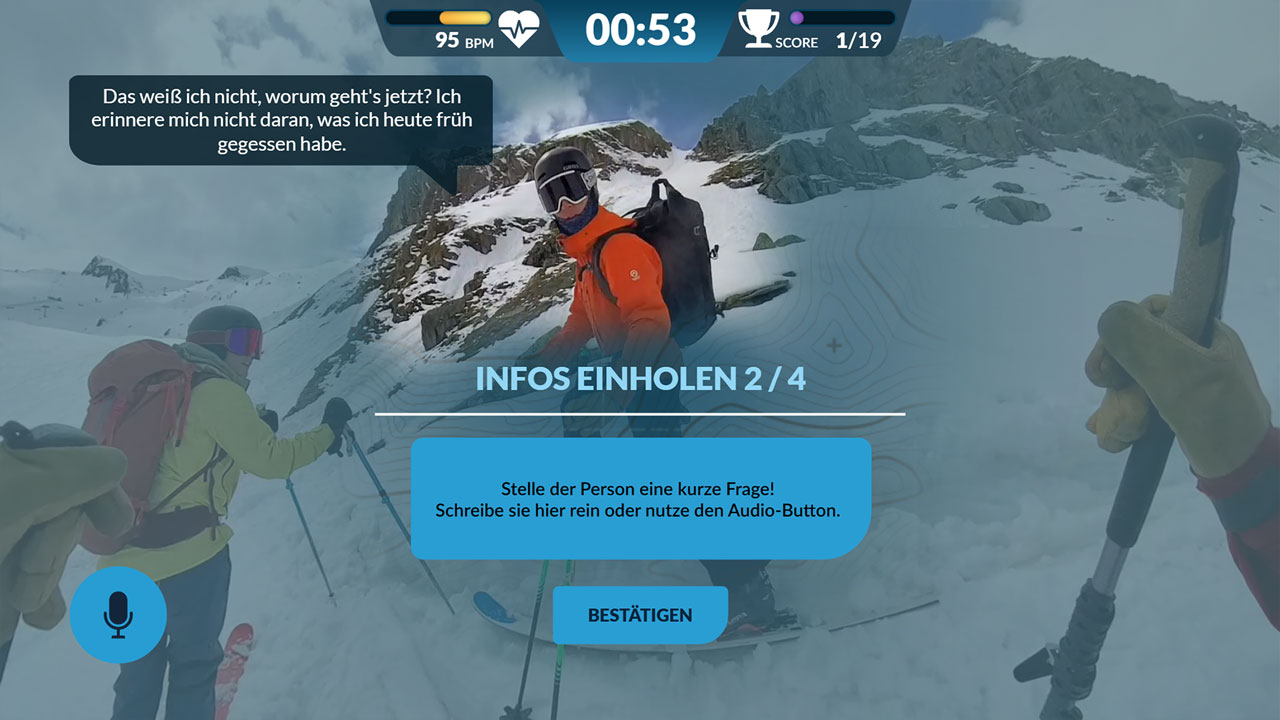
schneeWISE has run this for years, in real avalanche training. When you write the answer yourself instead of recognising it from three options, you actually think the situation through before you answer. That's the part that sticks when it counts.
Processed in the EU. Not stored.
What happens to my team's answers?
Each answer is processed only to check it against the model answers your experts defined. It isn't stored, isn't used to train any model, and is processed in the EU. In a scenario, your people describe the situation in the exercise, not real patients or real people, so no personal data leaves the training. For defence and classified work we set up a self-hosted or EU-only model on request.
Does the AI decide if my team is right?
No. Your experts write the answers that count as right. The AI reads what your team said and checks it against those answers. The standard is your expert's, the AI just applies it to every learner at once.